







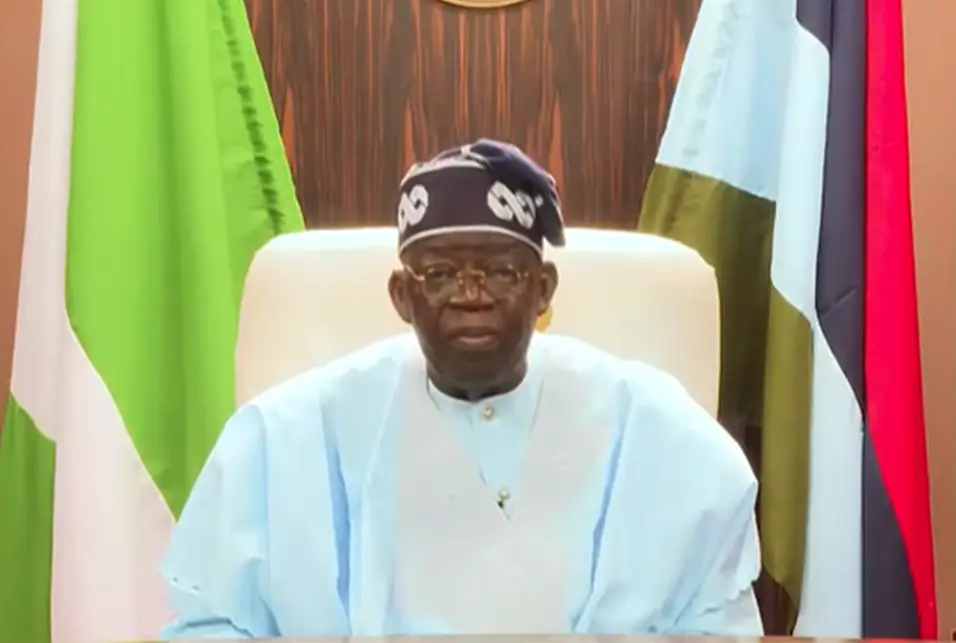
President Bola Ahmed Tinubu addressed the nation on Thursday, as Nigeria marked 66 years of independence. The speech was frank, reflective, and forward-looking. Here are the 10 key things he said.
1. Nigeria has endured, but the journey has been hard:
Tinubu acknowledged that while the country has survived war, military rule, economic crises, and insecurity, the journey has generally been “too hard for too many.” He praised ordinary Nigerians, farmers, traders, teachers, young entrepreneurs, and the Armed Forces for keeping the country going.
2. The promise of independence is yet to be fulfilled:
He reminded Nigerians that the founding fathers did not struggle just for a flag or an anthem. Independence carried a bigger promise: freedom to shape our destiny and build a nation of opportunity and dignity. Sixty-six years later, he said, it is now our responsibility to deliver that promise.
3. Nigeria was like a cancer patient choosing between treatment and morphine
In one of the most striking parts of the speech, Tinubu compared Nigeria’s past economic situation to a cancer patient. The doctor offers painful treatment with a strong chance of recovery, or morphine to dull the pain while the disease spreads. For too long, he said, Nigeria’s leaders chose morphine, postponing difficult decisions and passing the consequences to the next generation.
4. His reforms were painful but necessary
Tinubu admitted the reforms his administration introduced were difficult and had real side effects. But he insisted they did not create the problems, they confronted them. He warned against “regressive voices” calling for a return to “addictive subsidies,” urging Nigerians to resist that “siren song.”
5. The economy is improving
He listed gains: over 4% economic growth this year, falling inflation, reduced oil theft, rebuilt foreign reserves, a stabilised exchange rate, and record non-oil exports exceeding $6 billion in 2025. International observers and the private sector, he said, have confirmed that the reforms have strengthened Nigeria’s economic stability.
6. The age of reform is over; the age of prosperity begins
This was the headline message. Tinubu declared that the emergency treatment is finished and the foundation has been repaired. The new focus is “shared and widespread prosperity”, not just bigger statistics, but affordable food, reliable power, credit for businesses, jobs for young people, and hope for hard-working families.
7. His priority is to bring down the cost of living
He said his government will lower the cost of producing and moving goods Nigerians consume. The plan includes mechanised irrigation, dry-season farming, better access to seeds and fertiliser, improved storage and transportation, and completing roads, railways, and ports that connect farms and factories to markets.
8. Jobs and enterprise are at the heart of his policies
Tinubu said Nigeria’s young population must become an engine of production, not despair. He promised to use gas to power new industries, revive factories in industrial centres, expand digital connectivity, invest in skills, and support Nigerian businesses with infrastructure and finance. He wants to see more Nigerian farms feeding cities, Nigerian businesses selling to the world, and young Nigerians building unicorns at home.
9. He acknowledged that many Nigerians are struggling today
He admitted that some families still struggle for the next meal, school fees, medical bills, or transport money. Their hardship, he said, did not begin with his reforms — it is the result of decades of low productivity and failed institutions. He said government cannot erase in four years what accumulated over generations, but it can change the course. He pointed to the National Social Register, the Nigerian Education Loan Fund, CREDICORP consumer credit, and improved healthcare and education as bridges to prosperity.
10. Nigeria has crossed its own Red Sea, – no looking back
In a biblical analogy, Tinubu said Nigeria has “corrected its course” and “passed through our own Red Sea.” He urged Nigerians not to look back, but to move forward with faith in themselves and the country. The Promised Land, he said, is a Nigeria of abundance and opportunity, where prosperity is broadly shared and every child can dream beyond the circumstances of their birth.